Thomas Traddles
David CopperfieldThomas Traddles is a schoolfellow of David Copperfield who grows from a frequently caned Salem House pupil into a loyal friend, a capable legal professional, and a steady ally in the effort to recover Mr. Wickfield’s affairs. His good humor never means that he accepts injustice as harmless: he endures it himself, objects when others are mistreated, and turns friendship into practical help. Against the cruelty and self-interest around him, Traddles’s constancy is both a personal virtue and a quiet measure of character.
Identity and School Years
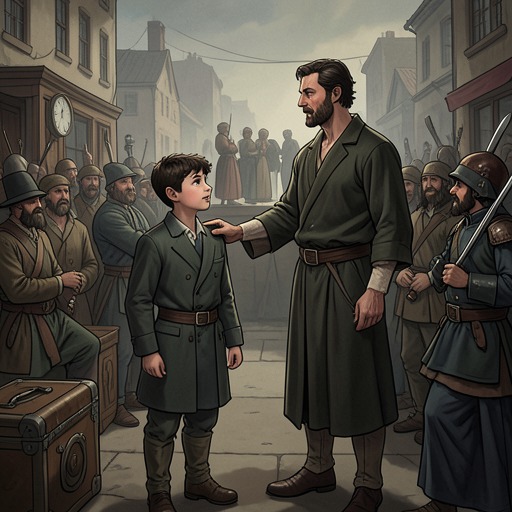
At Salem House, Traddles is a boy at once among the merriest and most miserable of the pupils. His tight sky-blue suit gives his arms and legs a comic appearance, but the joke does not soften the severity of his daily life: he is caned on almost every school day during the half-year, missing punishment only on one holiday Monday, when he is struck on both hands with a ruler instead. He would sometimes put his head down on his desk, then recover into laughter and cover his slate with skeletons. David first supposes the drawings remind Traddles that punishment cannot last forever; looking back, he thinks the simpler explanation is that skeletons were easy to draw because they needed no features.
The drawings register a repeated rhythm of injury and recovery, but Traddles’s endurance is not mere passivity. He can be hurt, and he feels the indignity of it, yet he finds his way back to good humor. That combination distinguishes him from the school’s governing logic, in which authority is displayed through corporal punishment and pupils have little power to contest it.
Loyalty and Resistance at Salem House
Traddles regards standing by the other boys as a solemn duty. When J. Steerforth laughs in church and the beadle mistakenly identifies Traddles as the offender, Traddles does not expose the real culprit. He is taken out before the congregation, suffers further punishment, and spends hours imprisoned; afterward his Latin Dictionary is covered in skeletons. The price of his silence is real, but so is the recognition it earns: J. Steerforth says that Traddles is no sneak, and the boys treat this as high praise. David, who considers himself less brave, remembers how much he would have been willing to endure for the same approval.
That loyalty becomes public again when J. Steerforth humiliates Mr. Mell. Traddles calls out against the insult, though Mr. Mell immediately orders him to be quiet. Mr. Mell then tells J. Steerforth that insulting someone less fortunate, who has given no offence, is a mean action. After Mr. Mell leaves the school, Mr. Creakle praises J. Steerforth for defending Salem House’s independence and respectability, and the boys are made to cheer. Traddles is caned for being found in tears instead of cheering. He later says he does not care about the punishment: Mr. Mell was ill-used. He also confronts J. Steerforth with the consequence of his conduct—hurting Mr. Mell’s feelings and costing him his position. Traddles’s loyalty thus reaches beyond protecting a schoolmate from blame; it includes naming the harm done to a vulnerable adult, even when the school’s authority endorses the wrongdoer.
Friendship and Practical Help
As an adult, Traddles remains a dependable friend to David. He appears punctually at David’s door despite obstacles, and David welcomes his sober judgment when an unsettling letter from Mr. Micawber arrives. Traddles has already consulted with Mr. Micawber about what he intends to do and advised him as well as he can. His friendship is expressed not as indiscriminate approval but as attention, counsel, and readiness to take responsibility.
That readiness has a cost. During a period of financial embarrassment, Mr. Micawber has changed his name to Mortimer and keeps out of sight; an execution for rent is put into Traddles’s household. Unable to resist Mrs. Micawber’s distress, Traddles has put his own name to a second bill. He is glad that the matter has been settled and that Mrs. Micawber has recovered her spirits, but the incident shows how easily his generosity can expose him to another person’s liabilities. David offers to enlist Clara Peggotty’s help, on the condition that Traddles solemnly resolve to lend his name or anything else to Mr. Micawber no more. Traddles’s kindness is therefore paired with a friend’s effort to give it firmer limits.
Traddles also helps David build a working future. When David considers reporting debates in Parliament, Traddles investigates the requirements and explains that mastery of shorthand, in both writing and reading, may demand a few years of perseverance and is, apart from rare cases, comparable in difficulty to learning six languages. David does not abandon the plan. Traddles adapts his help to David’s ability, dictating speeches at a manageable pace and pausing when needed. Night after night, often almost every night after David returns from the doctor’s, the two hold a private Parliament in Buckingham Street. Traddles turns an intimidating technical skill into sustained practice, making his friendship materially useful to David’s ambitions.
Witness, Counsel, and Professional Judgment
Traddles also supports David in his pursuit of Dora Spenlow. When the Misses Spenlow permit David to visit, he arranges to attend with his friend Traddles of the Inner Temple. During the visit, David appeals to Traddles to confirm the earnestness of his love. Traddles responds warmly but in plain, practical terms, and his testimony makes a favourable impression. His role is not to speak in place of David, but to give David’s feelings credible support before others.
Later, Traddles’s own professional competence becomes central to the effort to counter Uriah Heep. He identifies himself as Mr. Wickfield’s agent and friend and produces a power of attorney authorizing him to act in Mr. Wickfield’s affairs. He insists that the deed of relinquishment already discussed must be handed over to him. Then, examining the papers, he distinguishes an initial mass of accidental confusion from the deliberate confusion and falsification that followed. Once the funds are counted and the records put in order, he concludes that Mr. Wickfield can wind up his business and agency-trust without any deficiency or defalcation. Traddles’s steadiness here has a different form from his schoolboy loyalty: careful attention to documents and authority helps turn a concealed financial wrong into a matter that can be assessed and addressed.
Character and Narrative Role
Traddles’s defining trait is not simply cheerfulness, but a durable decency that survives punishment without becoming indifference. At Salem House, he protects another boy by keeping silent, then openly objects when J. Steerforth harms Mr. Mell. In adulthood, the same commitment appears as generosity toward the Micawbers, patient instruction for David, and responsible advocacy for Mr. Wickfield. Across these situations, loyalty does not mean that Traddles cannot be mistaken or overextended: signing Mr. Micawber’s bill places him in difficulty, and David has to ask him to stop lending his name. Yet his readiness to help is not a pose; it repeatedly has practical consequences for the people he supports.
Near the end of David’s account, Traddles accompanies him to the prison where Mr. Creakle now holds power. The immense, solid building has been erected at vast expense. Approaching its gate, David contrasts that expenditure with the public outcry that would have greeted spending half as much on an industrial school for the young or a refuge for deserving old people. Traddles is part of this visit, which brings the former schoolmaster’s authority into a new institutional setting and lets David measure the prison against neglected forms of care. The former Salem House pupil who once endured its punishments now stands beside David as a trusted adult witness to another system of confinement. Across the novel, Traddles’s recurring importance lies in that combination of personal fidelity and clear-eyed assistance: he remains kind without being uselessly sentimental, and dependable without needing the narrative’s centre to be his own.